

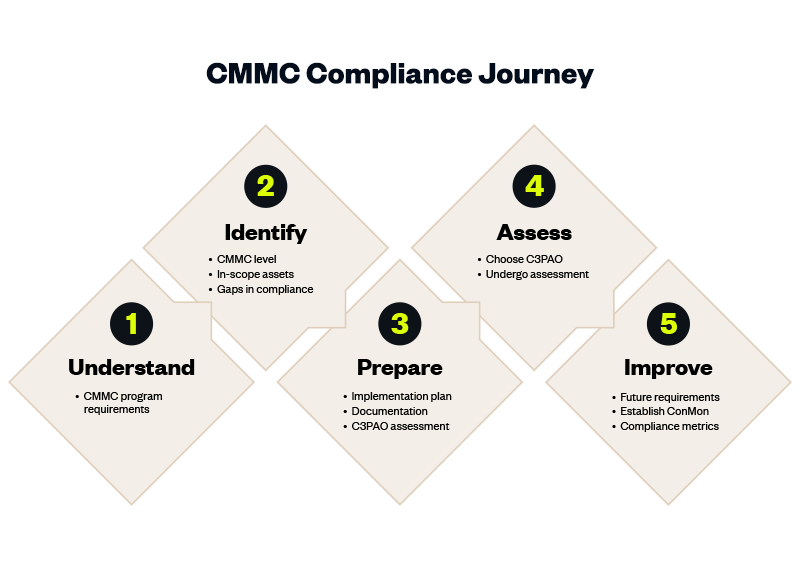
There’s a reason CMMC assessments rarely go smoothly on the first attempt—it’s not because organizations are lazy or careless. The issue often comes down to misreading or oversimplifying the expectations. Certified Third Party Assessment Organizations (C3PAOs) have noticed specific slip-ups that pop up across industries, from defense contractors to maritime and education-focused businesses.
Misinterpreting Controlled Unclassified Information (CUI) Requirements
CUI isn’t always labeled with a bright red sticker. It can hide in emails, embedded in old PDFs, or even in vendor invoices. Many organizations assume they don’t handle CUI, simply because it isn’t clearly marked. That misunderstanding leads them to skip over entire sections of the CMMC level 2 requirements—creating gaps that C3PAOs flag immediately. Understanding where and how CUI lives in your environment is one of the first steps toward solid CMMC level 2 compliance.
Another common error? Organizations treat CUI protection the same way they handle general business data. That’s a quick route to non-compliance. CMMC compliance requirements for CUI include access control, encryption in transit and at rest, and strict documentation. If you’re not identifying and isolating CUI, you’re not just making a mistake—you’re inviting audit failure. A c3pao isn’t looking for guesses; they want evidence that you understand the scope of your obligations.
Inadequate Documentation and Evidence Collection
Here’s a blunt truth: verbal assurance means nothing to a c3pao. If your team claims you’re following a practice but there’s no document trail, it won’t pass. That’s one of the biggest differences between cmmc level 1 requirements and cmmc level 2 compliance. At level 2, the bar is higher—processes must be documented, repeatable, and provable.
Many companies assume that evidence collection is just taking screenshots or saving PDFs. It’s not. Evidence has to show how and why your security measures exist, how they tie into your policies, and how they’re actually used. Logs, policy reviews, incident records—these are what a c3pao expects to review. In short: if it isn’t written down, it doesn’t count.
Underestimating System Security Plan (SSP) Complexity
The System Security Plan isn’t a one-and-done document. It evolves with your environment. Too often, organizations treat the SSP like a checkbox task—fill it out, attach a few policies, and consider it done. But cmmc level 2 requirements demand an SSP that reflects every part of your infrastructure, including third-party integrations and legacy systems.
A generic SSP copied from a template can tank an assessment. Each control needs to be tied to actual practices and technologies in your environment. CMMC RPOs may help you draft it, but ultimately, it’s your responsibility to ensure it tells the full story. A well-built SSP acts like a blueprint for how you protect CUI, not a placeholder to get through an audit.
Poorly Managed User Access and Permissions
Let’s be honest—access control tends to be messy. Teams grow fast, contractors come and go, and admin rights often stick around longer than they should. This is one of the top reasons assessments hit a wall. C3PAOs regularly flag organizations that fail to enforce the principle of least privilege, even when they believe they are.
What really causes issues is the lack of periodic access reviews. Assigning permissions is only half the work; auditing them is where many fall short. CMMC level 2 compliance requires organizations to have tight control over user roles and justify why someone has access to certain data. It’s not just about setting limits—it’s about proving you maintain them.
Weak Implementation of Multi-Factor Authentication (MFA)
It’s easy to assume that enabling MFA for a few key apps is enough. Unfortunately, partial MFA coverage doesn’t meet CMMC compliance requirements. A C3Pao will check whether MFA is consistently applied across all users, all systems that process CUI, and all remote access points.
Where most companies falter is legacy systems or administrative accounts. Some older platforms might not support MFA out of the box—but that’s not an excuse. You’re expected to either upgrade, isolate, or wrap those systems in compensating controls. CMMC RPOs often warn clients that skipping MFA on just one endpoint could derail the entire assessment.
Insufficient Training and Awareness for Key Staff
Training isn’t just about compliance—it’s about culture. Too many companies view training as an annual checkbox activity. But under cmmc level 2 compliance, training needs to be role-based, scenario-specific, and tracked. If your engineers don’t know how to report a suspicious login, or your procurement team doesn’t understand CUI handling, you’re at risk.
Even worse is when management assumes awareness filters down automatically. In reality, everyone from system admins to help desk personnel needs clear guidance on cybersecurity expectations. C3PAOs look for proof that staff understand not just the “what,” but the “why” behind your policies. You can’t fake that in a one-hour slideshow.
Neglecting Continuous Monitoring and Incident Reporting
Monitoring isn’t just for large breaches—it’s about noticing the small signs before they grow. This is one of the least understood parts of cmmc level 2 requirements. Many companies think installing an antivirus product and reviewing logs quarterly checks the box. It doesn’t.
C3PAOs want to see active and ongoing monitoring, with alerts, log correlation, and a real incident response plan. Not only should incidents be tracked, they should be analyzed and learned from. If you don’t have a playbook for reacting to an attack, or if your logs are unreviewed and siloed, then your cybersecurity posture is incomplete. This requirement alone separates surface-level efforts from truly mature operations.