
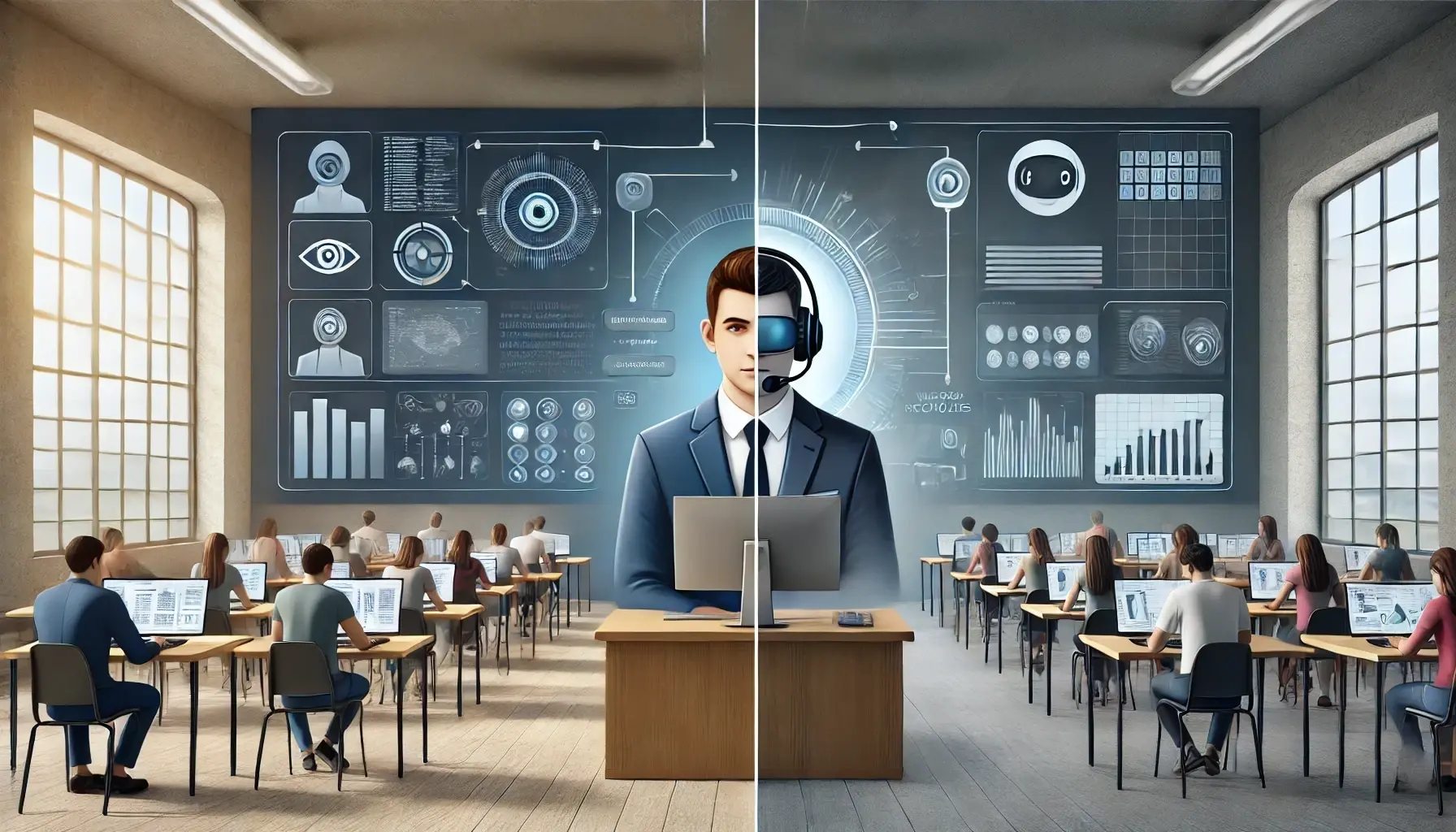
The rapid evolution of artificial intelligence has reshaped many aspects of education—but nowhere is the debate more pronounced than in the world of online proctoring. As educational institutions strive to maintain academic integrity in remote assessments, a critical question arises: Should proctoring be primarily human-led, AI-led, or a strategic combination of both?
This article explores the capabilities, limitations, and ideal configurations of human and AI proctoring approaches, offering guidance for institutions seeking robust, scalable, and trustworthy assessment solutions.
What Makes AI-Led Proctoring Appealing
One of the key drivers behind the surge in adoption of AI-led assessment tools is the demand for a scalable and efficient exam proctoring solution. Institutions under pressure to deliver secure, high-volume testing across dispersed locations are increasingly turning to automated systems to meet these logistical challenges.
Using machine learning algorithms, AI proctoring platforms monitor candidate behaviour via webcam, microphone, and screen activity, flagging anomalies such as unusual eye movement, background noise, or multiple faces in the frame.
Such tools are well-suited to high-volume testing environments where real-time human oversight is impractical. They can operate 24/7, adapt across time zones, and eliminate examiner fatigue—challenges that often plague human invigilators.
Furthermore, automation ensures a standardised baseline. Unlike human invigilators, AI does not vary its scrutiny based on mood or unconscious bias. It applies consistent criteria across all test-takers, helping ensure fairness in detection, if not always in interpretation.
The Limits of Automation in High-Stakes Contexts
Despite its advantages, AI alone is not a panacea. Automated proctoring systems may misinterpret legitimate behaviour, such as reading aloud, fidgeting, or glancing away to think, as potential violations. These false positives can undermine trust in the platform and cause undue stress for test-takers.
Equally important is the ethical dimension. Some institutions and regulators raise concerns about algorithmic transparency, privacy, and student consent. When students are monitored by opaque AI systems, questions emerge: Who determines what behaviour is suspicious? Is the technology culturally biased? Are the data being stored securely?
In high-stakes assessments, such as professional certification, final-year exams, or entrance testing, these concerns warrant significant attention. An entirely automated approach, while efficient, may not meet the pastoral care expectations that educational institutions are expected to uphold.
What Makes Human Proctors Essential in Assessment
Human invigilators bring an irreplaceable advantage: contextual judgement. Trained professionals can distinguish between a student briefly shifting posture and one actively attempting to cheat. They can also intervene in real time, offering warnings or assistance when needed.
In fact, a comparative study of AI-based and human-led proctoring found that human proctors identified fewer violations on average (25.95%) compared to the AI system (35.61%), which also produced 74 incorrect decisions across 244 exam attempts, suggesting that people were better at discerning genuine misconduct from innocuous behaviour.
In sensitive assessments, especially those involving neurodiverse learners or individuals with specific accommodations, human oversight allows for a more flexible and empathetic experience. People, unlike algorithms, can recognise and account for nuance.
Why Hybrid Proctoring Often Strikes the Right Balance
For many institutions, a hybrid model offers the best of both worlds. AI handles the initial monitoring and flagging, reducing the load on human proctors. Humans then review flagged events and make final determinations.
This layered approach enhances both accuracy and fairness. It allows for the scale of AI, but anchors decision-making in human judgment. Many platforms now offer configurable proctoring options where institutions can dial the level of automation up or down depending on the stakes of the exam.
Hybrid systems also foster better audit trails. Recorded sessions with timestamps, logs of flagged incidents, and human review notes can be compiled into a comprehensive evidence base, supporting appeals processes and academic integrity reviews.
Choosing the Right Fit for Your Institution
Ultimately, the “best” proctoring configuration depends on a host of factors: exam stakes, student demographics, data governance requirements, and institutional policies on privacy and equity.
Institutions must conduct a clear needs analysis, weighing the trade-offs between cost, scalability, user experience, and risk tolerance. Trials, feedback cycles, and clear communication with students and staff are essential when implementing or upgrading proctoring solutions.
For assessments where scale and speed are paramount, AI-led tools may suffice. But where fairness, accessibility, and academic rigour are critical, human oversight remains indispensable.