

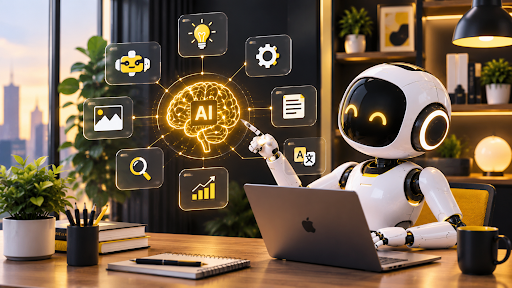
Artificial Intelligence, or AI, is one of the most talked-about technologies today. But what does it actually mean? In simple terms, artificial intelligence is a technology that lets computers and machines perform tasks that usually require human thinking.
AI can learn from information, recognize patterns, understand language, make predictions, and help people solve problems. You may already use AI every day without even realizing it. From voice assistants and online recommendations to navigation apps and chatbots, AI has become part of modern life.
What Is Artificial Intelligence?
Artificial intelligence is a type of computer technology designed to perform tasks that normally need human intelligence. These tasks can include learning, problem-solving, understanding language, recognizing images, and making decisions based on information.
Think of AI as a computer system that learns from examples instead of simply following one fixed set of instructions. For example, if an AI system receives thousands of pictures of cats and dogs, it can learn the patterns that help it tell the difference between them.
AI does not actually think or feel like a human. Instead, it uses data, mathematical models, and computing power to find patterns and produce useful results.
How Does Artificial Intelligence Work?
So, how does AI actually work? The basic idea is easier than it may sound.
AI systems are trained using large amounts of data. This data could include text, images, videos, sounds, numbers, or other types of information. The system studies this data and looks for patterns.
Once it learns these patterns, the AI can use them to make predictions or generate an appropriate response. For example, a chatbot can study huge amounts of language data and then use what it has learned to answer a user’s question.
If you want a more detailed look at how AI technology works, understanding the relationship between data, models, and predictions is a good place to start.
Examples of Artificial Intelligence
You probably interact with AI more often than you think. One common example is a voice assistant. Tools such as Siri and Alexa can understand spoken questions and respond to them using AI technology.
Recommendation systems are another everyday example. When Netflix, YouTube, or another platform suggests a movie, video, or song you might enjoy, AI can help make those recommendations based on your previous activity and other patterns.
Chatbots are also powered by AI. They can understand questions, process language, and generate responses. Navigation apps use AI-related technologies to analyze traffic information and help users find suitable routes.
These examples show that AI is not only something used in advanced research. It is already built into many digital products and services people use every day.
How Is AI Used in Everyday Life?

Artificial intelligence is used in many areas of daily life. Your smartphone may use AI for voice recognition, photo organization, translation, and personalized suggestions.
Online shopping websites can use AI to recommend products based on your searches and previous activity. Banks may use AI systems to identify unusual transactions and help detect possible fraud.
Businesses also use AI for customer support, data analysis, content processing, automation, and other tasks. In healthcare, AI can assist professionals with analyzing information and identifying patterns in medical data.
As AI technology continues to develop, its role in everyday activities is likely to become even more common.
Types of Artificial Intelligence
When people talk about AI, they are not always talking about the same kind of system. There are different ways to classify artificial intelligence.
Most AI applications today are examples of narrow AI. These systems are designed to perform specific tasks. A recommendation system, translation tool, or voice assistant is built for particular purposes rather than general human-like intelligence.
Artificial General Intelligence, often called AGI, refers to a more advanced concept in which a machine could understand and perform a wide range of intellectual tasks similar to humans. AGI remains a concept and research goal rather than something commonly available today.
Benefits of Artificial Intelligence
AI can help people complete tasks faster and process large amounts of information. Instead of manually checking thousands of pieces of data, an AI system may be able to analyze the information much more quickly.
Businesses can also use AI to automate repetitive tasks, improve customer experiences, and discover patterns in their data. For individuals, AI-powered tools can make searching, writing, translating, planning, and finding information easier.
The goal is not always to replace human work. In many situations, AI works as a tool that helps people save time and make better use of their skills.
Challenges of Artificial Intelligence
Although AI offers many benefits, it also comes with challenges. AI systems depend heavily on the quality of the data used to train them. If the data contains problems or bias, the results may also be unreliable or unfair.
Privacy is another important concern because many AI applications work with large amounts of information. There are also questions about job changes, misinformation, security, and how AI-generated content should be used.
This is why responsible development and human oversight are important when using artificial intelligence.
Why Is Artificial Intelligence Important?
AI is important because it is changing how people interact with technology. Instead of simply following basic commands, modern software can analyze information, understand natural language, recognize patterns, and provide personalized results.
For businesses, this can create new ways to automate work and understand customers. For everyday users, AI can make many digital tools easier and more useful.
Conclusion
In simple words, artificial intelligence is technology that enables computers and machines to perform tasks that normally require human intelligence. AI learns from data, identifies patterns, and uses what it learns to produce predictions, recommendations, or responses.
You can already see AI in chatbots, smartphones, recommendation systems, navigation apps, online shopping, and many other services. While AI brings useful opportunities, it also creates challenges that need careful attention.
The easiest way to understand AI is to think of it as a tool that helps computers learn from information and perform intelligent tasks. As the technology continues to improve, understanding the basics of AI can help you make sense of the digital world around you.
Frequently Asked Questions
What is artificial intelligence in simple words?
Artificial intelligence is technology that allows computers and machines to perform tasks that usually require human intelligence, such as understanding language, recognizing patterns, learning from data, and making predictions.
What is an example of artificial intelligence?
Chatbots, voice assistants, recommendation systems, navigation apps, and image recognition tools are common examples of artificial intelligence.
How does AI learn?
AI systems learn by processing data and identifying patterns within it. During training, the system uses examples to improve its ability to produce useful results when it receives new information.
How is AI used in daily life?
AI is used in smartphones, search engines, social media, streaming platforms, online shopping, navigation apps, banking systems, and customer service tools.
Is artificial intelligence the same as human intelligence?
No. AI can perform many tasks that appear intelligent, but it does not have human emotions, consciousness, or understanding in the same way people do. It processes information using computer models and data.




