

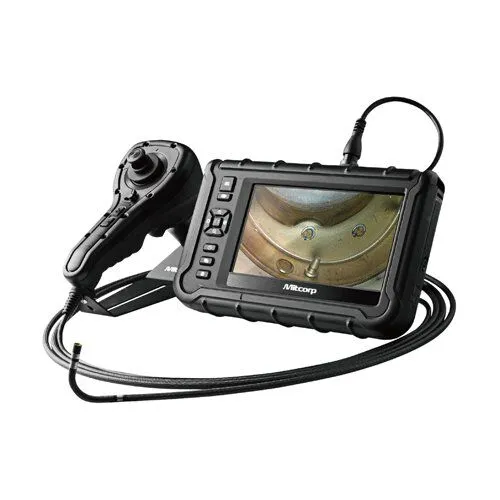
If you’ve ever tried to inspect inside an engine, turbine, pipe or tight cavity, you’ll know that a straight, non-bending camera only gets you so far. That’s where borescope articulation comes in. It’s the ability of the probe tip to bend on command so you can “look around corners” and aim the camera exactly where you need it.
Modern articulated borescopes let inspectors steer the tip with fine control, helping them see defects that would otherwise stay hidden—from cracks on the back of a blade to corrosion tucked behind an internal lip.
What do we mean by borescope articulation?
At its simplest, articulation is the controlled bending of the borescope’s distal end (the tip) from the operator side. Instead of the probe behaving like a stiff rod, you can move a control and watch the tip smoothly curve inside the component you’re inspecting.
Articulation is usually described in terms of:
- Direction – how many ways the tip can bend (2-way vs 4-way)
- Degree – how far the tip can bend (for example, up to 180°)
- Responsiveness – how smoothly and precisely the tip follows your input
Articulation turns a borescope from a simple “peek inside” tool into a true search and locate instrument.
Fixed vs articulating borescopes
Fixed (non-articulating) probes
Non-articulating borescopes have a fixed, straight probe. You can still see inside cavities, but your viewing angle is limited to whatever line-of-sight the insertion point allows. These scopes are:
- Simpler and often more affordable
- Ideal for straight bores or where access is perfectly aligned
- Less suitable for complex geometries or hidden surfaces
Articulating probes
Articulating borescopes add steering control at the tip. This allows you to:
- Look behind features, around bends or back toward the insertion point
- Examine multiple surfaces from one access point
- Reduce the number of ports or disassembly steps needed for inspection
In many industries, articulated probes have become the default choice because they dramatically increase what you can actually see inside a component.
The main types of borescope articulation

2-way articulation
With 2-way articulation, the tip bends in two opposite directions—often “up” and “down.” This is sufficient for many inspections where the access path is relatively straight, but you need to look slightly off-axis or back at a critical surface.
2-way articulated scopes are common in:
- Automotive and diesel engine inspection
- Basic turbine and compressor checks
- General maintenance tasks where complexity is moderate
4-way articulation
4-way articulation gives you up, down, left and right movement. That means you can sweep the tip through a wider angular range and orient the camera to almost any direction from a single position.
This is especially useful when:
- Navigating complex internal geometries
- Inspecting blades, vanes and welds from multiple angles
- Working in high-value assets where access is limited and tear-down is expensive
The role of articulation in different industries
In sectors like aviation, power generation, oil and gas and heavy manufacturing, articulated borescopes are integral to non-destructive inspection and preventative maintenance. They help engineers visually confirm the condition of parts deep inside engines, turbines, boilers and pipework without dismantling major assemblies, as reflected in the range of inspection-heavy industries that rely on remote visual tools.
Manual vs powered articulation
Mechanical (manual) articulation
Most articulated borescopes use a mechanical system—typically cables running inside the insertion tube—connected to a control knob, lever or joystick. When you move the control, the cable tension changes and the tip bends accordingly.
Manual systems are valued for:
- Direct, intuitive feel
- High reliability when well designed
- No need for additional motors or power at the tip
Motorised or assisted articulation
Some advanced video borescopes incorporate motorised articulation, where small motors or actuators help drive the tip. These systems can:
- Provide very smooth motion
- Reduce operator fatigue during long inspections
- Enable pre-programmed or repeatable movement patterns
However, they are typically more complex and costly, and are usually reserved for high-end applications where the extra control is justified.
Why articulation matters in real-world inspections
Seeing critical defects, not just “something”
Without articulation, you may know that “something” is inside a component, but not be able to truly understand its shape, depth or exact location. Being able to angle the tip and view a feature from multiple directions helps you distinguish between:
- Surface discoloration vs a crack
- A harmless deposit vs a foreign object that must be removed
- Superficial wear vs damage that justifies taking equipment offline
Better visual information leads to better decisions about maintenance, repair or replacement.
Reducing disassembly and downtime
Articulation allows you to inspect more from fewer access points. Instead of drilling extra ports or dismantling large assemblies, you can often reach all necessary surfaces from existing openings. That means:
- Shorter outage times
- Lower labour costs
- Less risk of damage during disassembly and reassembly
Making inspections more efficient and repeatable
Experienced inspectors develop a routine where they systematically steer the borescope through specific paths and angles. Consistent articulation helps them:
- Compare current conditions with past inspections
- Document findings with photos and videos from repeatable viewpoints
- Train new technicians to follow the same inspection routes
For organisations running regular inspection programmes, the combination of reliable articulation and professional support services is crucial. Remote visual inspection providers like USA Borescopes back their equipment with inspection-focused services that help keep borescopes performing in demanding environments.
Choosing the right level of articulation
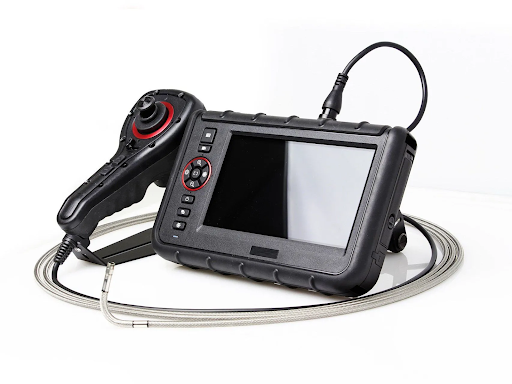
Not every job requires high-end, 4-way, motorised articulation—but many benefit from at least basic steering capability. When deciding what you need, consider:
- The complexity of the components you inspect
- How often you must look “backwards” or sideways from the access point
- The consequences of missing a defect
- Your budget and how frequently the borescope will be used
For some users, a simpler 2-way articulating system is more than enough; for others, particularly in aviation and power generation, a fully featured 4-way video borescope is a necessity, not a luxury.
USA Borescopes specialises in remote visual inspection equipment and understands how different industries and applications influence articulation requirements, probe configurations and feature sets. Their team draws on real-world experience across sectors to help organisations choose systems that balance capability, durability and cost, as outlined on their About Us page.
If you’re considering your first articulated borescope or thinking about upgrading from a non-articulating system, it’s worth speaking with a specialist who can walk through your inspection challenges, recommend suitable configurations and explain the trade-offs clearly. To discuss your needs or request guidance on articulated borescope options, contact USA Borescopes today.
About the Author
This article was written by a technical content specialist focused on inspection technologies, maintenance workflows and non-destructive testing. They work with industrial equipment providers to translate complex engineering concepts into practical, plain-language guides that help reliability teams, inspectors and buyers choose the right tools for critical assets.